

It’s a summer storm, the kind Sydney does well. The downpipe by the back door is overflowing, the lawn has turned into a pond, and water is creeping towards the house. That’s usually the first time anyone thinks about stormwater drainage.
Sydney gets a lot of its rain in bursts, so a house block has to move a lot of water in a short time. When the system is in good shape, you never notice it. When one part is blocked, undersized or broken, the water finds its own way. It’s rarely a way you’d choose.
So here’s how it all fits together: how stormwater drainage works on a typical property, where the water ends up, who is responsible for which part and what your options are when something isn’t coping. Where we have a detailed guide on a topic, we’ve linked to it so you can read further.
What Is Stormwater Drainage?
Stormwater is rain that runs off hard surfaces such as roofs, driveways and paving instead of soaking into the ground. Stormwater drainage is the set of gutters, pipes, pits and drains that collects that water and carries it away from your home.
Are sewer and storm drains the same?
No. A lot of people assume they are, and it’s one of the most useful things to get straight about your property. Sydney Water explains that wastewater and stormwater are managed using two separate pipe systems.
The sewer takes used water from your toilets, sinks, showers and laundry to a treatment plant. A stormwater drain takes rainwater only. The two should never be connected to each other.
Why stormwater isn’t treated
Unlike wastewater, stormwater isn’t treated before it flows into creeks, rivers and the ocean. Whatever washes into a rainwater drain, including soil, leaves, oil and detergent, can end up in a local waterway. That’s a good reason to keep paint, chemicals and garden waste well away from your drains.
How Stormwater Drainage Works on a House Block
A residential system has four parts working in sequence. Follow a raindrop from the roof to the street and you’ll pass through each of them.
Gutters and downpipes
Gutters catch rain coming off the roof and feed it into downpipes. The downpipes carry it to ground level. In most cases they should connect into an underground stormwater pipe, not spill onto the ground beside the house. Our guide on connecting downpipes to stormwater covers what’s expected in NSW.
Surface drains, grates and pits
Paved areas, driveways and low spots in the yard need their own collection points. Grated strip drains catch water running across hard surfaces. Stormwater pits collect surface water and act as junctions where several pipes meet.
Underground pipes
Below ground, pipes carry the collected water across the property. They need a steady fall so the water keeps moving and doesn’t leave silt behind. Out of sight, and often out of mind until something backs up.
The point of discharge
The pipes finish at an approved discharge point. For many Sydney homes that’s the kerb and gutter at the street. For others, particularly blocks that slope away from the road, it’s a drainage easement or an inter-allotment drainage line shared with neighbours. Your council decides what counts as a legal point of discharge for your property.
Where Does Stormwater Go?
From your property to the street
Sydney Water describes stormwater as flowing from property drains to street gutters operated by local councils. From the gutter, it drops into the kerb inlets you see along the roadside.
From the street to waterways
Those gutters connect to larger channels, pipes and creeks. Eventually the water reaches rivers, harbours and the ocean. Along the way, devices such as gross pollutant traps catch some of the litter, but the water itself isn’t cleaned the way sewage is.
So a rainwater drain in your backyard is the first link in a chain that ends at a beach or a river. That’s worth remembering when you’re washing the car or hosing down a paint tray.
Who Is Responsible for Stormwater Drains?
This one causes a lot of confusion, especially when a blockage or a flooded yard involves a neighbour. The short version is below.
Your side
As the property owner, you look after the stormwater system on your land. That includes gutters, downpipes, pits, grates and the pipes running to the discharge point.
Council’s side
Councils look after the public system: street gutters, kerb inlets and the pipes under the road. Local councils also have primary responsibility for flood planning. In some parts of Sydney, the larger channels and trunk drains belong to Sydney Water.
Shared lines and easements
If your stormwater runs through a neighbour’s land in an easement, or several properties share one line, responsibility is usually shared between the owners who use it. It’s helpful to check your property title and talk to your council before any work.
For a fuller explanation, including what happens when water from one property affects another, see our guide to who is responsible for stormwater drains in NSW.
Residential Stormwater Drainage Solutions
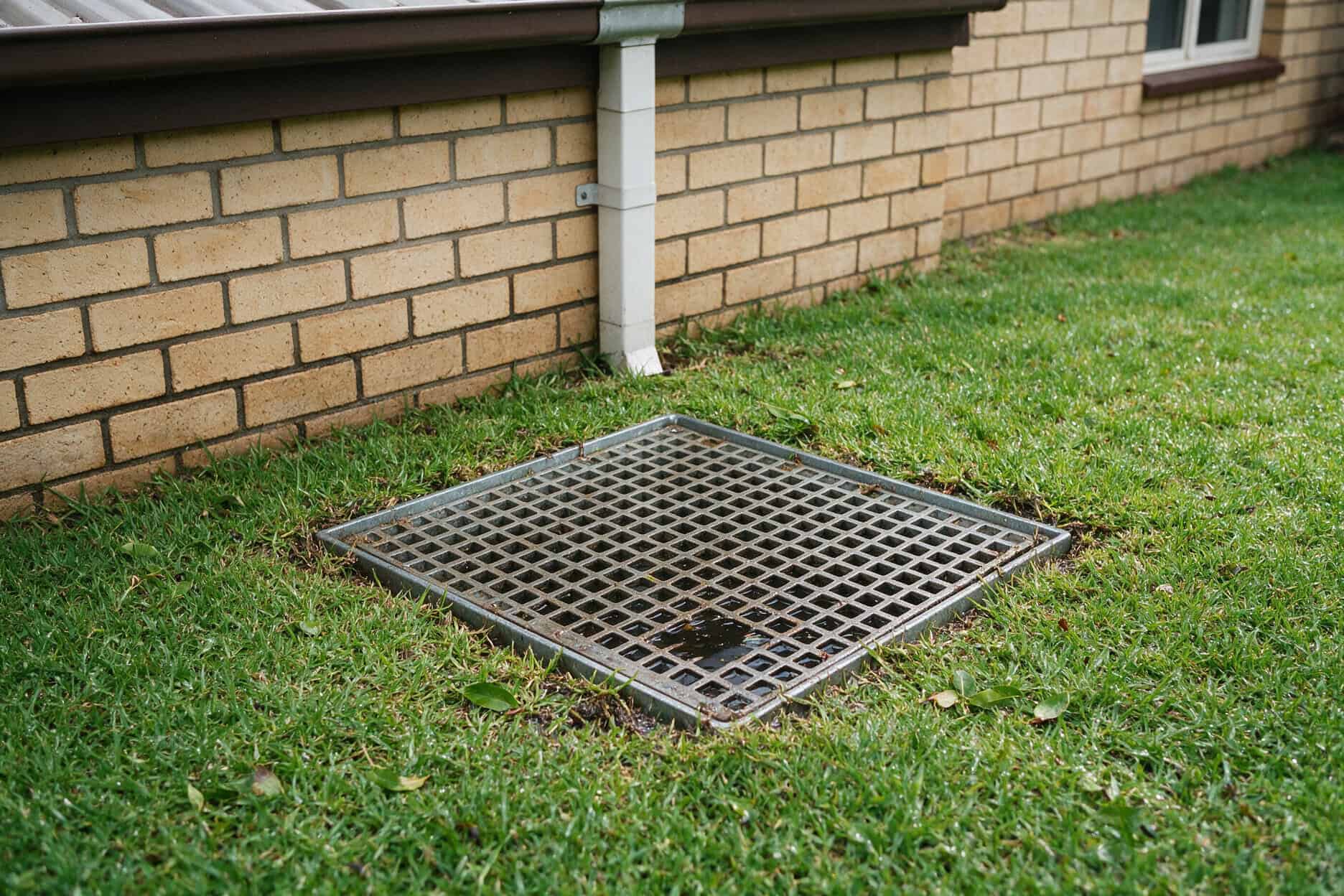
ALT text: A square grated stormwater pit set into a lawn beside a brick house with a downpipe on the wall.
Description: A grated stormwater pit sits flush in the lawn next to a brick wall, close to a downpipe. It shows one of the most common residential stormwater drainage solutions, a pit that collects surface water and pipes it away.
When part of the system isn’t coping, the fix depends on where the water is collecting and why. There’s no single answer. These are the common residential stormwater drainage solutions, and many homes end up with a mix of them.
Pits and surface drains
A low spot that floods, or a driveway that sends water towards the garage, usually needs a collection point. A grated pit or strip drain catches the water and pipes it away. Our stormwater pit installation guide explains the types, sizes and NSW rules.
Subsoil drains
A soggy lawn or a damp wall below ground level often comes from water in the soil, not on the surface. A subsoil drain (often called an ag drain or French drain) is a slotted pipe laid in a gravel trench that collects groundwater and leads it away.
Rainwater tanks and on-site detention
A rainwater tank takes some of the load off the system by holding roof water for later use. Some newer homes and renovations also need an on-site detention system, which holds stormwater during a storm and releases it slowly, so the street drains aren’t overwhelmed. Your council sets these requirements.
| Problem | Likely solution | Who to talk to |
| Downpipe overflowing | Clear the blockage, check the connection | Plumber |
| Water pooling on paving or driveway | Grated strip drain or pit | Plumber |
| Soggy lawn or damp subfloor | Subsoil drain | Plumber |
| Water flowing in from a neighbour | Check responsibilities, then drainage design | Council, then plumber |
| New build or major renovation | Detention system, approved discharge | Council and a drainage designer |
What Size Stormwater Pipe Do You Need?
There isn’t one answer for stormwater pipe sizes in Australia. It’s worth being a little cautious of any chart that suggests there is.
The right size depends on three things:
- How much area drains to the pipe. A large roof or a wide driveway sends more water than a small one.
- How hard it rains where you live. Designs are based on local rainfall intensity, which differs across Sydney.
- How much fall the pipe has. A pipe with a steeper fall carries more water than a flatter one of the same diameter.
Sizing is set out in the Australian plumbing standard for stormwater drainage (AS/NZS 3500.3). A licensed plumber or drainage designer works it out for your site. A pipe that’s too small will back up in heavy rain, even if it’s perfectly clear.
How Much Does Stormwater Drainage Cost?
How long is a piece of string? Stormwater work ranges from a quick unblocking to a full new system, so costs vary widely. The main factors are:
- The type of job. Clearing a blocked line is very different from installing new pits and pipework.
- How much digging is involved. Trenching through lawn is simpler than cutting through concrete or paving.
- Length and depth of pipe. More metres and deeper trenches take more time and materials.
- Access. Tight side passages and established gardens slow things down.
- Council requirements. Some work needs approval or an engineered design.
The most reliable way to get a figure is a site visit and a fixed quote. A drain camera inspection first can also show whether an existing pipe can be cleaned or relined instead of replaced.
What Are the Signs Your Stormwater Drainage Is Failing?
It’s helpful to catch problems early, before a big storm does it for you. Look out for:
- Gutters or downpipes overflowing in moderate rain.
- Water pooling near the house and taking days to drain.
- Pits that stay full of water or silt.
- Damp patches, musty smells or mould along lower walls.
- Erosion or washed-out garden beds along the path the water takes.
- Water coming up out of a pit or grate during rain.
Simple maintenance that helps
A simple routine can prevent most of these problems:
- Clean gutters at least twice a year, and more often if you have overhanging trees.
- Lift grates and scoop out leaves and silt from pits before storm season.
- Check that downpipes are still connected at the base and haven’t cracked.
- Watch where water goes during heavy rain. It’s the easiest way to spot a problem early.
Leaves, silt and tree roots are the usual causes of a blocked line. If clearing the grates and gutters doesn’t help, the blockage is likely underground. Our team can help with a blocked stormwater drain in Sydney, using a camera to find the cause and jet blasting to clear it.
Wrapping Up
Stormwater drainage is a simple idea with a few moving parts: collect the rain, carry it across your block and release it at an approved point. It’s a separate system from the sewer, it isn’t treated, and the part on your land is yours to maintain.
A little routine maintenance goes a long way. Clean gutters and grates before storm season, keep an eye on how the yard drains after rain, and deal with small problems before they become damp walls.
If water is pooling, overflowing or heading where it shouldn’t, it might be time to have a licensed plumber take a look. You can find all our guides and services at Rapid Service Plumbing.
Key Takeaways
- Stormwater drainage collects rain from roofs and hard surfaces and carries it to an approved discharge point.
- Stormwater and sewer are two separate systems. Stormwater isn’t treated before it reaches waterways.
- A house system runs from gutters and downpipes, through pits and underground pipes, to the kerb or an easement.
- You’re responsible for the system on your property. Council looks after the street drainage.
- Common fixes include pits, strip drains, subsoil drains, tanks and detention systems.
- Pipe size depends on catchment area, rainfall and fall, and is set by AS/NZS 3500.3.
- Overflowing downpipes, pooling water and damp lower walls are signs to act on.