
A small bathroom doesn’t have to mean sacrificing style or function. Working with compact space forces creativity, and the result is often a bathroom more practical and beautiful than you imagined. The right design choices completely transform how your space feels and performs.
We’ll walk you through 11 ideas that genuinely work, from timeless principles to 2025 trends. Some you can implement today, others might spark your next renovation.
Quick Reference: Small Bathroom Design Strategies
| Strategy | Impact | Best For |
|---|---|---|
| Light colours | Creates illusion of space | Every small bathroom |
| Mirrors strategically placed | Reflects light, doubles visual space | Limited natural light |
| Wall-mounted fixtures | Frees up floor space | Studios, apartments, ensuites |
| Large-format tiles | Fewer grout lines, cleaner look | Floors and walls |
| Vertical design elements | Draws eye upward | Low ceilings |
| Open showers | Removes visual barriers | Bathrooms under 5 sqm |
| Floating vanities | Makes floor visible | Creates spacious feel |
| Recessed storage | Keeps clutter hidden | Limited wall space |
1. Light Colours Create Space and Openness
When your bathroom is small, colour palette matters. Light, neutral, and bright colours reflect light and create an airy feeling that makes the space feel significantly larger. Think whites, soft greys, pale blues, and warm beiges.
Monochromatic schemes work brilliantly here. Using various shades of the same colour creates visual continuity without feeling boring. Pair soft grey walls with slightly darker grey cabinetry and light tile for depth while maintaining that spacious feel.
2. Natural Light Transforms Your Space
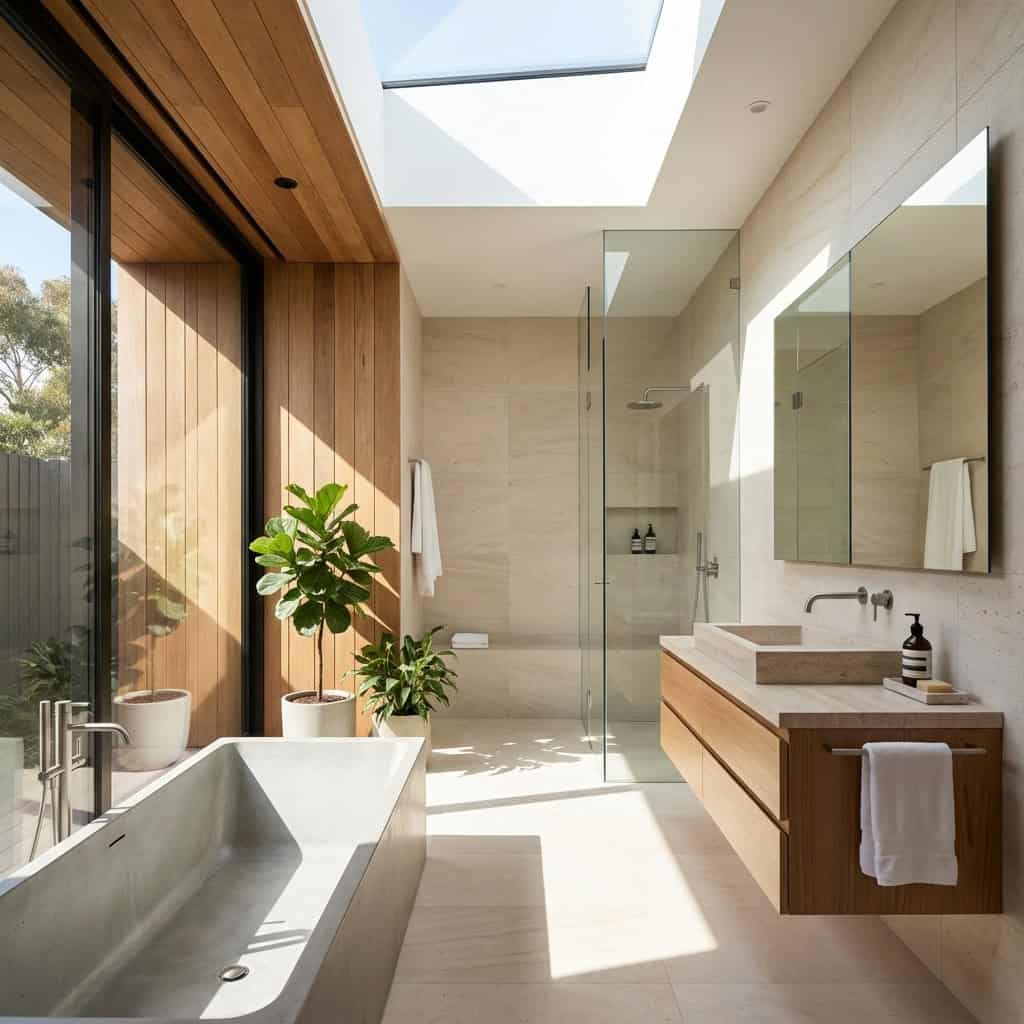
You don’t need to knock out walls to add more light. A simple window, skylight, or clever use of existing openings fills your bathroom with natural light and makes the space feel instantly more open. If your bathroom has a window, use sheer or translucent coverings that let light through while maintaining privacy.
If you don’t have a window, consider a skylight. Modern options from trusted Australian brands completely change how the room feels throughout the day. Natural light has a psychological benefit too. Spaces flooded with daylight feel calmer and more connected to the outdoors, even when they’re tiny.
3. Artificial Lighting: The Secret Weapon
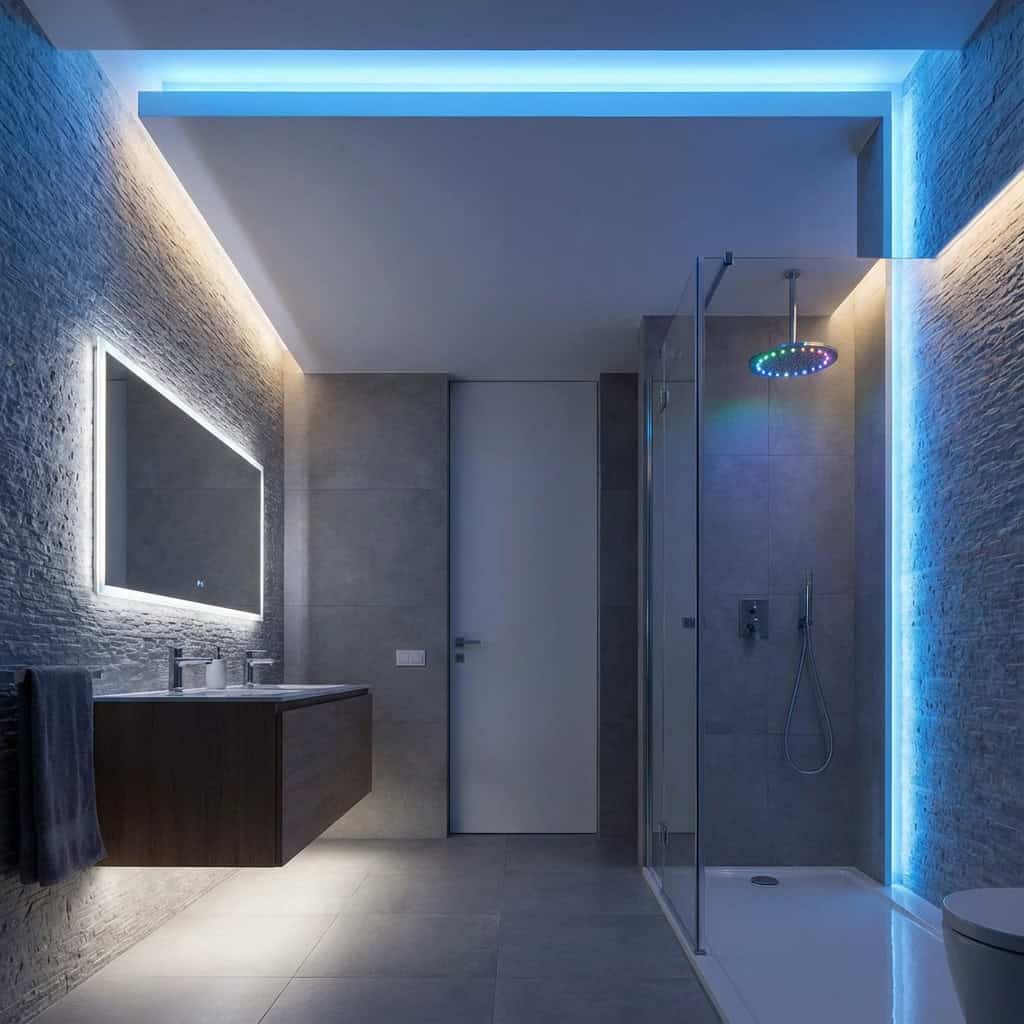
Light is everything in small bathrooms. Dark shadows make spaces feel cramped. Layer your lighting instead of relying on a single overhead. Use recessed lights for general brightness, task lighting around the vanity for grooming, and accent lighting to highlight features. LED lights are ideal because they use less energy and last longer.
LED mirror lights are trending in small bathrooms right now. They provide practical task lighting while adding a modern touch. Backlit mirrors bounce light around the room and make bathrooms feel more spacious. If you’re adding power points, ask your electrician about USB outlets too. Modern bathroom products increasingly use USB charging.
4. Mirrors: The Space-Expanding Illusion
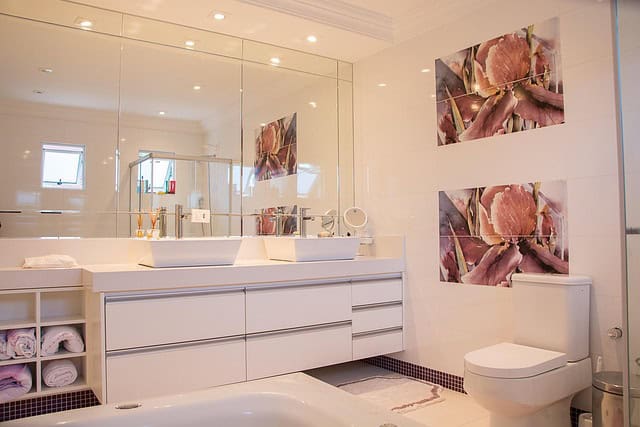
Mirrors are practically magical for creating the illusion of space. They reflect light and visually extend what you see beyond the walls. Go large with mirrors rather than small ones above the sink. Consider floor-to-ceiling or multiple large mirrors positioned strategically opposite windows or light sources to bounce natural light around the room.
An oversized mirror above the vanity becomes a design feature, not just functional. Pair it with brushed gold or matte black framing for a contemporary look. Arched mirrors are trending for 2025 and add a softer, more welcoming aesthetic to compact spaces.
5. Wall-Mounted Fixtures: Free Up Your Floor
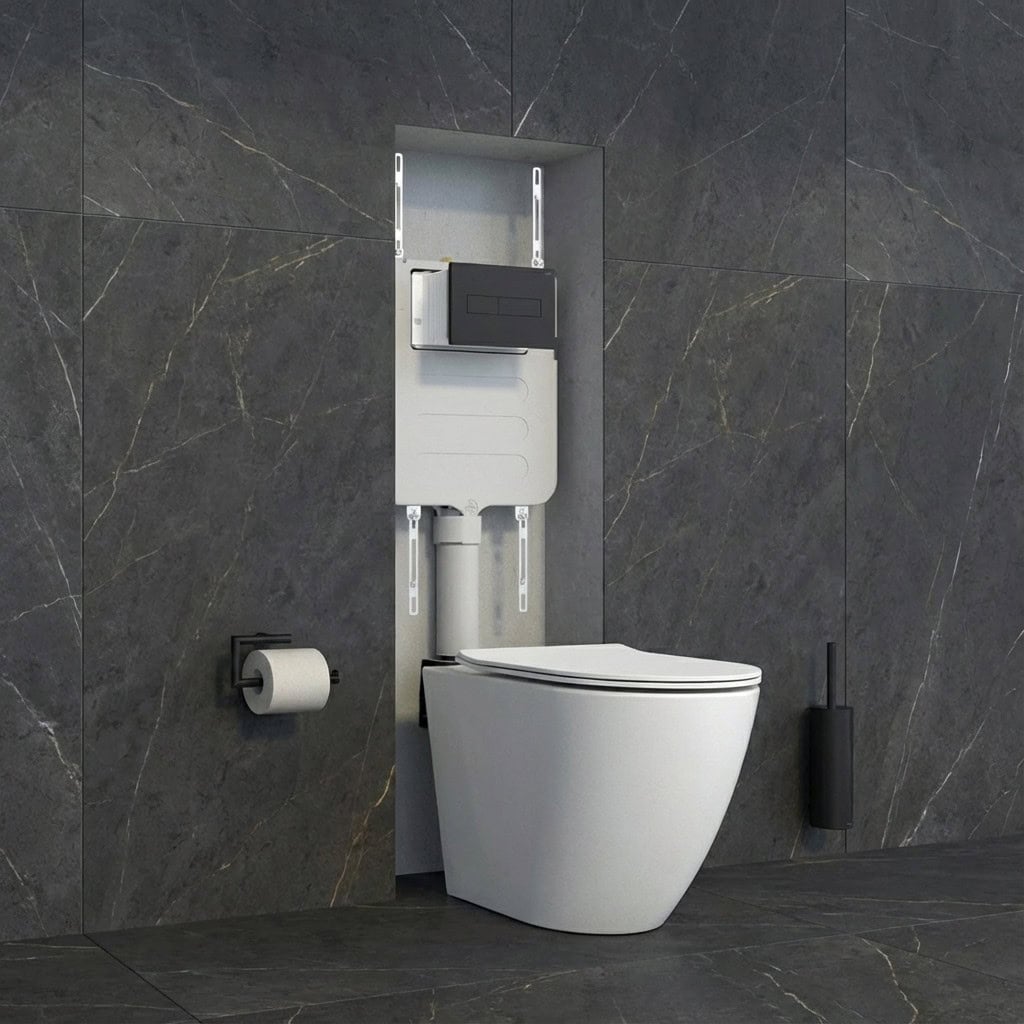
Every square centimetre of floor space matters in a small bathroom. Wall-mounted fixtures free up floor area, create openness, and make cleaning easier. A wall-hung toilet with in-wall cistern looks sleek while making the room feel significantly more spacious than traditional floor-mounted versions. The visible floor underneath is crucial for that open feeling.
Floating vanities with open space underneath, wall-mounted shelves, and recessed storage all eliminate bulky footprints. If you’re considering plumbing changes for wall-mounted fixtures, chat with a plumber early about what’s practical for your space.
6. Glass or Open Showers: Removing Visual Barriers
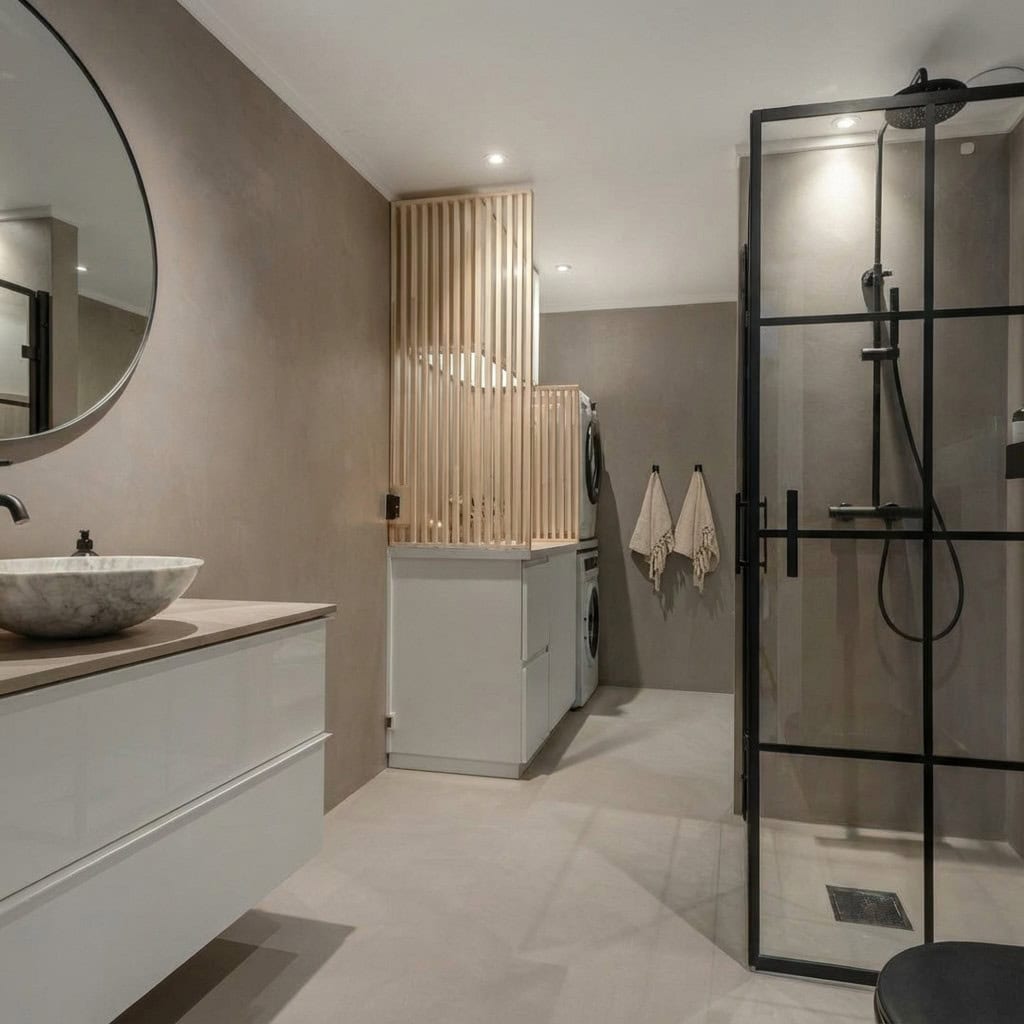
The shower dominates a small bathroom, so design matters enormously. A traditional shower with a solid curtain creates a visual barrier that makes the space feel smaller and more enclosed. A frameless glass screen keeps the space feeling open while protecting your bathroom from water.
An open or doorless shower is even better if your layout allows it. These blend seamlessly with the rest of the bathroom, virtually eliminating visual boundaries. If an open shower isn’t practical, use clear glass rather than frosted. The transparency maintains sightlines throughout the room.
7. Minimalism: Less Is More
When floor space is limited, clutter becomes your biggest enemy. Get rid of what you don’t absolutely need. If you can live without a bath, skip it entirely. This alone frees up significant space. Remove purely decorative elements, keep accessories minimal, and store everything inside cabinets and drawers.
Clear sightlines make small bathrooms feel larger. Quality over quantity transforms tight spaces into feeling deliberate and luxurious. One beautiful soap dispenser beats three cluttered bottles. One artwork beats five decorative items.
8. Smart Storage Solutions That Work
Storage is non-negotiable in small bathrooms, but how you do it matters. Bulky cabinets eat up space. Instead, think vertically and creatively. Recessed shelves built into shower walls provide practical storage without eating into your footprint. Floating shelves hold towels and essentials without taking up floor space.
Mirror cabinets serve double duty, providing storage while reflecting light. Hidden storage is your friend. Magnetic strips hold grooming tools, drawers in vanity units keep supplies organised, and bathroom niches provide storage that doesn’t feel like storage.
9. Vertical Lines: Draw the Eye Upward
In small bathrooms with lower ceilings, vertical lines draw the eye upward, creating an illusion of height. Achieve this through vertical stripes in wall art, tall slender fixtures, or how you arrange tiles. Vertical tile patterns like subway tiles laid vertically or statement walls naturally guide the eye upward and make compact spaces feel less cramped.
Tall, narrow storage solutions work better than wide, squat ones. A vertical heated towel rail takes up less floor space than traditional horizontal rails while providing warmth and storage. These are trending for small bathroom renovations because they deliver luxury without consuming square metres.
10. Continuity: Seamless Design Across Surfaces
One underrated design trick for small spaces is visual continuity. When floors, walls, and ceilings share similar design elements, the eye doesn’t register boundaries. This tricks the brain into perceiving a larger, more unified space. Consider using the same colour or material across walls, flooring, and shower surround.
Continuous large-format tiles create a seamless look. Even subtle continuity helps. Light grey walls with grey flooring create visual flow that makes everything feel more connected and spacious. This principle also applies to cabinetry and fixtures. Matching your vanity colour to your walls creates continuity rather than contrast.
11. Sliding Doors: Maximise Every Centimetre
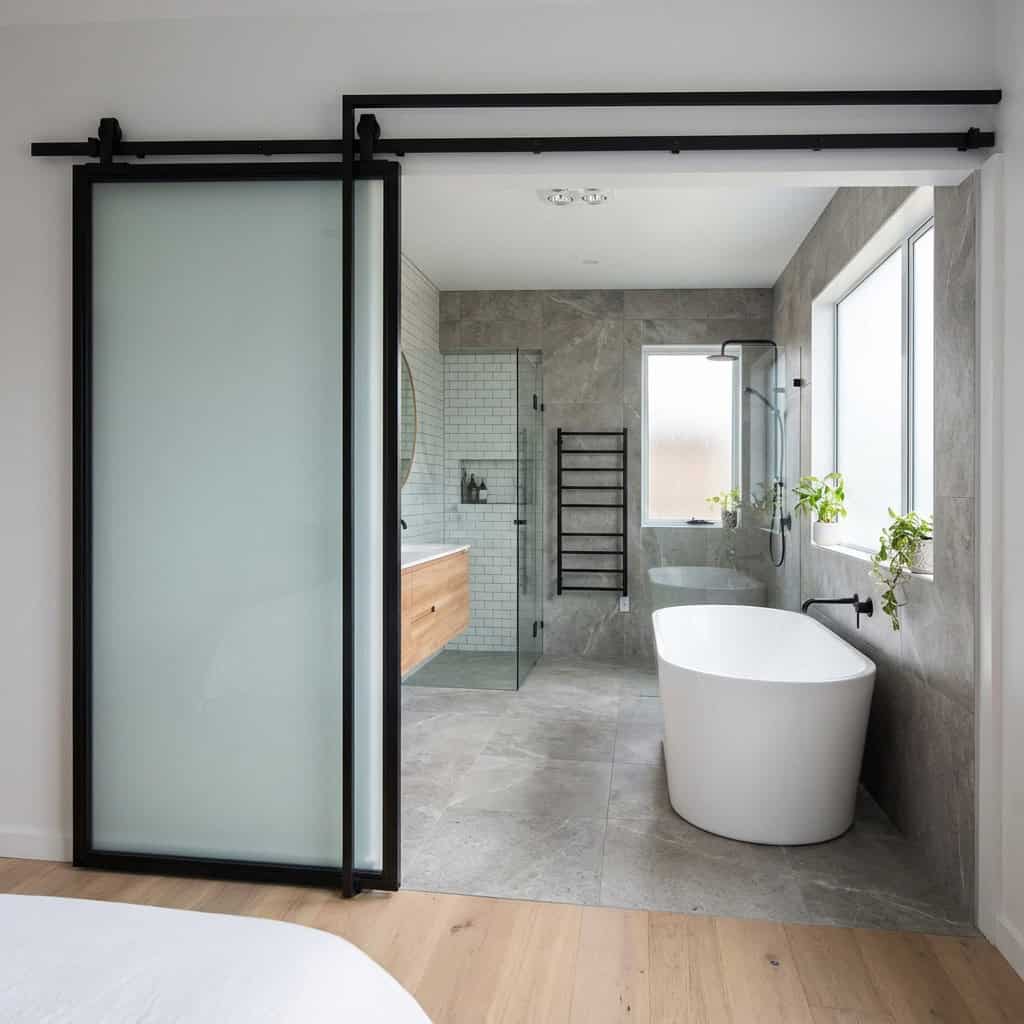
Traditional swinging doors are space killers in small bathrooms. A standard door swing needs clearance, directly reducing usable floor space. Sliding doors eliminate this problem entirely and free up space for movement or storage.
Barn doors are trendy and functional, offering a design statement while freeing up floor space. Cavity sliders hide completely into the wall for an even cleaner look. Pocket doors and screens provide other options. Each creates usable space that a swinging door would consume.
New Trends: Small Bathroom Design for 2024 and 2025
| Trend | Why It Works for Small Spaces | How to Implement |
|---|---|---|
| Large-format tiles | Fewer grout lines = cleaner look, easier to clean | Use on floors and walls |
| Mixed tile formats | Adds visual interest without clutter | Combine large tiles with mosaic accents |
| Curved fixtures | Softens angular bathrooms, more inviting | Curved vanities, arched mirrors, rounded basins |
| Heated towel rails (vertical) | Luxury without floor space sacrifice | Replace traditional horizontal rails |
| Sensor taps and smart fixtures | Modern, hygienic, space-efficient | Touchless operation, occupancy sensors |
| Bold accent colours | Personality in minimal space | Feature wall or bold towel choices |
| Textured finishes | Adds depth without visual chaos | Grooved tiles, natural stone surfaces |
Smart Technology That Saves Space
Smart fixtures are practical for compact spaces, not just trendy. Sensor taps operate without handles, freeing up vanity space. Voice-activated mirrors provide information and lighting control without additional fixtures. Touch on/off LED mirrors provide practical lighting and modern aesthetics in one product.
These aren’t luxury additions anymore. Australian homes increasingly expect smart functionality because it genuinely improves how a small space works. If you’re renovating, ask your electrician and plumber about integrating smart technology. USB outlets in power points mean you can charge devices without cluttering your vanity.
Wet Rooms: The Ultimate Space-Saving Solution
A wet room, where the entire bathroom is waterproofed and slopes toward a drain, represents the ultimate in space-saving design. There’s no shower enclosure taking up space, no doors or barriers. Just an open, flowing space that works best in bathrooms under 5 square metres.
Wet rooms eliminate visual and physical barriers. You can position a shower nozzle anywhere, freeing you to use every corner. The waterproofing is crucial though, so this is a job for professional plumbers and builders familiar with modern Australian building codes.
Choosing Fixtures That Actually Fit
When working with limited space, fixture selection is critical. Some fixtures are easier to install in tight spaces than others. Corner sinks and quadrant showers tuck neatly into corners, freeing up space. Compact toilets and shortened bathtubs provide functionality in less space.
Wall-mounted everything (toilet, vanity, shelves) becomes possible with smart plumbing planning. If you’re considering fixture changes, chat with a plumber early. They’ll advise what’s practical for your space without requiring major replumbing.
Small Bathroom Layouts That Actually Work
| Layout | Best For | Advantages |
|---|---|---|
| One-wall layout | Narrow bathrooms | All fixtures on one wall, minimal movement |
| Corner configuration | Compact spaces | Uses corner space efficiently |
| Floating fixtures | Any size | Maximises visual space, easier to clean |
| Walk-through layout | Longer, narrower spaces | Allows movement without obstruction |
| Corner shower with floating vanity | Small bathrooms | Combines space-saving strategies effectively |
Quick Updates That Don’t Break the Bank
Not every improvement requires full renovation. Budget-friendly updates deliver surprising impact. Replace shower curtains with clear glass doors, swap out your mirror for a larger statement one, paint walls in light colours, and install floating shelves.
Add task lighting around the vanity, declutter and style what you keep visible. These updates cost a fraction of full renovation but noticeably improve how your space feels and functions.
Accessibility Matters in Small Spaces
Maximising space is important, but so is making your bathroom functional for everyone. If elderly family members or people with mobility challenges share your home, thoughtful design becomes critical. Wall-mounted fixtures provide easier access than floor-standing ones.
Grab bars can be incorporated into design rather than tacked on later. Wider doorways and clear floor space matter. A bathroom that’s both space-efficient and accessible is genuinely better designed overall.
Professional Help: When to Call a Plumber
Small bathroom renovations often involve plumbing changes. Moving pipes, installing in-wall cisterns, or adding wall-mounted fixtures requires professional expertise. A plumber can advise on what’s practical for your space and building codes.
Bathroom Drain Blocked? We Can Help!
Have you thought about calling a professional plumber to help design your small bathroom? At Rapid Service Plumbing, we’ve helped design and implement small bathroom ideas all across Sydney including Bankstown, Potts Point, Rushcutters Bay, North Rocks, Dulwich Hill, and Kirrawee and beyond, by:
Optimising the plumbing layout and infrastructure Helping you select bathroom fixtures and features Advising on plumbing modifications and ventilation Ensuring everything meets current building standards Guaranteeing quality workmanship
Is your bathroom tiny and do you need help implementing some of these small bathroom ideas across Sydney? Get in touch with Rapid Service Plumbing. We provide stress-free upfront pricing and a 100% workmanship guarantee for life. Give us a call today.
Key Takeaways
Small bathrooms aren’t a limitation, they’re an opportunity. Light colours, strategic mirrors, wall mounted fixtures, and smart storage transform tight spaces into functional, stylish rooms. The latest trends, from large format tiles to curved fixtures and smart technology, work beautifully in compact bathrooms when applied thoughtfully.
Your small bathroom can feel spacious, modern, and luxurious. It just requires intentional choices about every element. Start with the fundamentals: light, mirrors, vertical lines, and clear sightlines. Add your own style through colour accents and texture. The result is a bathroom you actually love using every single day.